Minggu, 16 September 2012

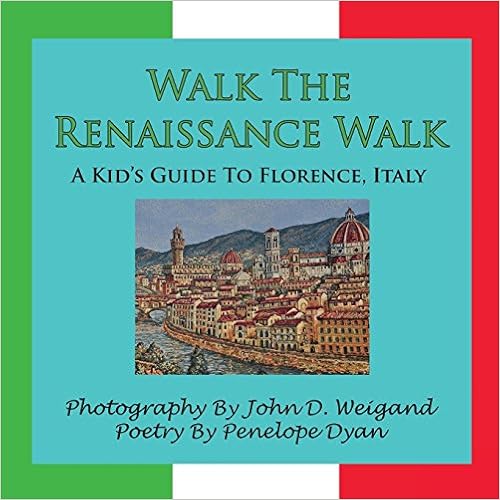
Free Ebook Walk the Renaissance Walk---A Kid's Guide to Florence, Italy, by Penelope Dyan

Free Ebook Walk the Renaissance Walk---A Kid's Guide to Florence, Italy, by Penelope Dyan

It is not impossible for you who are searching for the older book collection below. Yeah, we supply guides from all libraries worldwide. So, can you imagine? A lot of resources from worldwide can be discovered right here. You may not should open up resource to resource due to the fact that we provide you the appropriate link to get it. So, why don't you plan to get Walk The Renaissance Walk---A Kid's Guide To Florence, Italy, By Penelope Dyan right now? Let make a plan where you will certainly take this extremely amazing book. Then, just look for the other book collection that you need currently.

Walk the Renaissance Walk---A Kid's Guide to Florence, Italy, by Penelope Dyan

Walk the Renaissance Walk---A Kid's Guide to Florence, Italy, by Penelope Dyan


Walk the Renaissance Walk---A Kid's Guide to Florence, Italy, by Penelope Dyan


Free Ebook Walk the Renaissance Walk---A Kid's Guide to Florence, Italy, by Penelope Dyan

What to claim as well as what to do when mainly your close friends love reading? Are you the one that don't have such hobby? So, it is essential for you to start having that pastime. You understand, reading is not the force. We're sure that reading will lead you to participate in much better concept of life. Reviewing will certainly be a favorable activity to do whenever. And also do you understand our pals come to be followers of Walk The Renaissance Walk---A Kid's Guide To Florence, Italy, By Penelope Dyan as the very best publication to check out? Yeah, it's neither an obligation nor order. It is the referred publication that will certainly not make you feel let down.

Lots of responsibilities in this recent era require the book not only from the latest book, but additionally from the old book collections. Why not? We offer you all collections from the oldest to the most recent books worldwide collections. So, it is very finished. When you feel that the book that you have is really publication that you intend to check out now, it's so pleasured. Yet, we truly suggest you to check out Walk The Renaissance Walk---A Kid's Guide To Florence, Italy, By Penelope Dyan for your own necessity.

When increasing and promoting this publication we are also so sure that you can obtain the lesson and knowledge easily. Why? With your basic knowledge and also ideas, your choice to mix with the lessons provided by this publication is really remarkable. You can find the ideal option of exactly how the presented publication in this lesson is acquired. As well as currently, when you are actually find of this type of book topic, you could obtain the documents of the book in this sit.

Getting this publication in this site could not lead you to stroll as well as go to publication shop. Looking for rack by shelf will really spend your time primarily. Yet, it well not warranties you to be effective searching for Walk The Renaissance Walk---A Kid's Guide To Florence, Italy, By Penelope Dyan Hence, you can find it in the soft file of this publication. It will certainly provide you the fantastic system of the book recommendation. You can check out the web link and also go to the web page making handle. As well as currently, your publication sort data of this can be your picked book as well as area to read this interesting book.

Walk the Renaissance Walk---A Kid's Guide to Florence, Italy, by Penelope Dyan

Product details

Grade Level: 4 - 6

Paperback: 42 pages

Publisher: Bellissima Publishing LLC; 1st edition (June 12, 2009)

Language: English

ISBN-10: 9781935118701

ISBN-13: 978-1935118701

ASIN: 1935118706

Product Dimensions:

8.5 x 0.1 x 8.5 inches

Shipping Weight: 4.8 ounces (View shipping rates and policies)

Average Customer Review:

2.9 out of 5 stars

6 customer reviews

Amazon Best Sellers Rank:

#2,047,729 in Books (See Top 100 in Books)

This was a great disappointment, and I am sending it back. The pictures don't do justice to this spectular city at all. They are all very close in which is fine for the Bapistery doors, for instance, but the reader gets no - I mean NO - sense of the river and bridges, the vista of the Duomo, etc. The rhymes are worthless - "Donatello...a famous artist and quite a fellow" - I'm sorry to say, providing nothing to inform the young audience. Also, I'm no prude and the "David" is one of my favorite statues in the world, but I'm not sure close ups of this - twice! - in a children's book is really the place to focus. Lastly,to have misspellings of key names is unacceptable - the "Uffize" Gallery and "Da Vince", REALLY? Apologies to the authors - the idea of a children's travel book is great - but this one totally missed the mark.

A refreshingly different picture book with historical and geographical information. The simpler poetry is what keeps this history lesson moving right along and my 3 (yes, three!) year old engaged to the end. I'm thrilled! There are more scrubbed up, formal geography books for kids. I've seen them; I own some. But, the kids I read this geography series to (from Penelpe Dyan) eat it up and ask for more! I have had this experience before with well-know publishers of children's reading material, when it baffles my adult brain what could possibly be so engaging to my kids... whatever that "it" is, this book has it. Dyan was a teacher, and perhaps has the mysteries of the child-brain figured out. Bloopers and all, this book is a keeper!Walk The Renaissance Walk---A Kid's Guide To Florence, Italy

I have a ton of books by this author and my toddler loves them. I grew up on poems like the ones contained in the authors books and I only wish I could write them as well as the author does. My mother used to make up poems for me as a child. These books bring back memory's of the cute poems that my mother made for me on an almost daily basis. I love being able to share them with my toddler.

Short and sweet, these books tell a lot in the pictures. Kids giggle at the silliness of the text. I keep them on hand in my classroom. When I'm teaching about a place in the world covered by one of Dyan's books, I know I'm going to get a great picture to put up on the doc-cam. I am particularly taken with the cover photo of a tapestry. I noticed that the pictures are of things that caught my eye when I was visiting some of these places but the photos are so much better than mine. I like the large pictures and the depth and perspective they give. The book on Florence is one of my personal favorites. Each of the travel books gives a great "snapshot" of wonderful locations in the world. When my students tell me they are going to one of those places or just came back, we pull out the book for that place. The other day, one student was reading about Florence and another called out, "Do you have one on Mexico?" Well, it doesn't look like there's one yet, but I'll be watching for it. These books are a nice addition to my classroom library.

I have taken 11 grandchildren to Italy and any one of them could write a better book on Florence than this one. If there was an editor, s/he napped every few pages right through the typos. The pictures are of generally poor quality and the text can certainly not be called poetry. For instance, how about "The Uffize (sic) Gallery has many statues outside, And Florence is where once Galileo did reside, This is his statue that you can see, Looking as wise as once was he." Flip to the Duomo: "You can see the Duomo on the walk, And you may even stop and gawk. Because this is something that withstood time, Something that is quite sublime." Each of the 17 pages of text has one of these little gems in the middle of lots of white space, and that's what you paid for.I'm perfectly serious when I write that this is possibly the worst example of a book I have ever seen on any subject. Reviews on Amazon are not my habit, but I am a fervent patron and felt it was my duty to steer the rest of the Amazon family away from this useless book.

I agree with the first reviewer. The poetry in this book is utterly strange. The opening line reads, "To get to Florence you can take a train, After you arrive in Venice by plane". HUH???I could have quoted the whole bizarre book but that would have been too painful.

Walk the Renaissance Walk---A Kid's Guide to Florence, Italy, by Penelope Dyan PDF
Walk the Renaissance Walk---A Kid's Guide to Florence, Italy, by Penelope Dyan EPub
Walk the Renaissance Walk---A Kid's Guide to Florence, Italy, by Penelope Dyan Doc
Walk the Renaissance Walk---A Kid's Guide to Florence, Italy, by Penelope Dyan iBooks
Walk the Renaissance Walk---A Kid's Guide to Florence, Italy, by Penelope Dyan rtf
Walk the Renaissance Walk---A Kid's Guide to Florence, Italy, by Penelope Dyan Mobipocket
Walk the Renaissance Walk---A Kid's Guide to Florence, Italy, by Penelope Dyan Kindle

Walk the Renaissance Walk---A Kid's Guide to Florence, Italy, by Penelope Dyan PDF

Walk the Renaissance Walk---A Kid's Guide to Florence, Italy, by Penelope Dyan PDF

Walk the Renaissance Walk---A Kid's Guide to Florence, Italy, by Penelope Dyan PDF

Rabu, 22 Agustus 2012

PDF Download Introduction to Modern Dance Techniques

PDF Download Introduction to Modern Dance Techniques

As the other publication will give, besides the new lesson it will certainly likewise boost the impact and inspirations associated with this subject. We're truly certain that your choice to select as reading publication will certainly be not wrong. It assumes that the existence of the book will certainly enrich this globe's literary collections. When lots of people look for this topic for guide reading, it will certainly come to be the one that affect you to earn new ideas.

Introduction to Modern Dance Techniques

Introduction to Modern Dance Techniques


Introduction to Modern Dance Techniques


PDF Download Introduction to Modern Dance Techniques

Do you require brand-new reference to accompany your extra time when going to residence? Reading a book can be a good option. It could save your time usefully. Besides, by checking out book, you could improve your understanding and also experience. It is not only the science or social understanding; lots of things can be obtained after reviewing a book.

In investing the leisure time, many individuals have different means. However, to earn the same one, reviewing the Introduction To Modern Dance Techniques can be done completely. Even it is in different time, you all can acquire the features and also benefits of the book to review. It is sort of book with the particular topic to conquer the everyday issues. When you require kind of entertainment, this book is likewise ideal enough.

Exactly what should you assume a lot more? Time to get this Introduction To Modern Dance Techniques It is very easy then. You could only rest and remain in your location to get this book Introduction To Modern Dance Techniques Why? It is online publication store that give numerous compilations of the referred books. So, merely with internet link, you could take pleasure in downloading this book Introduction To Modern Dance Techniques as well as numbers of publications that are searched for now. By visiting the link page download that we have actually given, the book Introduction To Modern Dance Techniques that you refer a lot can be located. Simply conserve the requested book downloaded then you can take pleasure in the book to check out whenever and area you want.

This Introduction To Modern Dance Techniques ends up being a complement in your planning for far better life. It is to needed to get guide to acquire the very best vendor or finest author. Every publication has particular making you feel deeply about the message and also impression. So, when you discover this book in this website, it's far better to obtain this book soon. You can see just how an easy book will provide powerful perception for you.

Introduction to Modern Dance Techniques

Review

"Well researched. Useful for students in understanding roots/influences of contemporary dance." —Nada Diachenko, co-director of the department of theatre and dance, University of Colorado–Boulder "Much needed concepts in one book for next generation teachers." —Dr. Susan Kirchner, chairperson of the dance department, Towson University "I believe every public school dance teacher should have a copy in her classroom." —Pamela Sofras, chairman of department of dance, University of North Carolina–Charlotte "A useful text for modern dance technique classes at the high school or college level. It could be used throughout the typical four years of study or for a one-semester survey course of modern dance." —Journal of Dance Education (December 2012)"Ideal for an undergraduate dance history or pedagogy course, Introduction to Modern Dance Techniques explores the work of more than 10 modern dance choreographers. Includes descriptions of key exercises from each choreographer's class work." —Dance Teacher Magazine (August 2012)

Read more

About the Author

Joshua Legg is a choreographer, writer, poet, photographer, educator, and designer. He holds an MFA in dance, choreography, and performance and has taught for the dance and theater programs at Harvard University, Suffolk University, and Shenandoah University. He lives in Winchester, Virginia.

Read more

Product details

Paperback: 272 pages

Publisher: Princeton Book Company; 59236th edition (October 1, 2011)

Language: English

ISBN-10: 9780871273253

ISBN-13: 978-0871273253

ASIN: 087127325X

Product Dimensions:

7 x 0.6 x 9 inches

Shipping Weight: 1 pounds (View shipping rates and policies)

Average Customer Review:

4.8 out of 5 stars

8 customer reviews

Amazon Best Sellers Rank:

#459,415 in Books (See Top 100 in Books)

Think of this as a textbook clarifying all those names and techniques that dance teachers may have referenced while you were trying to concentrate on alignment or form (or just not falling over) during dance class through the years.I minored in dance in college but focused mainly on ballet. This book has helped to round out my modern education.If you're looking for a broad overview of the last century in concert dance, this may be a great resource for you as well. Legg covers the evolution of modern dance from Denishawn and Isadora Duncan to Paul Taylor and "Postmodernism." Familiarity of dance in general will probably be a big help!

A good useful book for a Dance History class. Not for an actual technique class unless you haveknowledge of the techniques explained in the book.

This is a well written modern dance history resource. It takes you through the history as well as the techniques of modern dance. It is a thorough resource for a modern technique class or a modern dance history course.

Exelente

This text has a great blend of the practical, the technical and the theoretical. Rarely do you see these aspects so well blended.

Perfect!

Wonderful. Received quickly.

100% Recommended

Introduction to Modern Dance Techniques PDF
Introduction to Modern Dance Techniques EPub
Introduction to Modern Dance Techniques Doc
Introduction to Modern Dance Techniques iBooks
Introduction to Modern Dance Techniques rtf
Introduction to Modern Dance Techniques Mobipocket
Introduction to Modern Dance Techniques Kindle

Introduction to Modern Dance Techniques PDF

Introduction to Modern Dance Techniques PDF

Introduction to Modern Dance Techniques PDF

Sabtu, 18 Agustus 2012

Download Ebook By Mancur Olson Jr. - The Logic of Collective Action: Public Goods and the Theory of Groups, Second printing with new preface and appendix

Download Ebook By Mancur Olson Jr. - The Logic of Collective Action: Public Goods and the Theory of Groups, Second printing with new preface and appendix

In this age of contemporary period, using net must be maximized. Yeah, web will help us very much not just for crucial thing yet additionally for day-to-day activities. Lots of people now, from any level could utilize net. The sources of web connection can additionally be enjoyed in numerous places. As one of the advantages is to obtain the online book, as the world window, as many individuals suggest.

By Mancur Olson Jr. - The Logic of Collective Action: Public Goods and the Theory of Groups, Second printing with new preface and appendix

By Mancur Olson Jr. - The Logic of Collective Action: Public Goods and the Theory of Groups, Second printing with new preface and appendix


By Mancur Olson Jr. - The Logic of Collective Action: Public Goods and the Theory of Groups, Second printing with new preface and appendix


Download Ebook By Mancur Olson Jr. - The Logic of Collective Action: Public Goods and the Theory of Groups, Second printing with new preface and appendix

We might not be able to make you love reading, however By Mancur Olson Jr. - The Logic Of Collective Action: Public Goods And The Theory Of Groups, Second Printing With New Preface And Appendix will certainly lead you to love reading beginning with currently. Book is the home window to open the brand-new globe. The world that you want remains in the far better phase and level. World will certainly constantly guide you to also the prestige stage of the life. You know, this is some of exactly how reading will certainly give you the kindness. In this instance, even more publications you find out more knowledge you recognize, but it can indicate also the bore is complete.

As one of guide compilations to recommend, this By Mancur Olson Jr. - The Logic Of Collective Action: Public Goods And The Theory Of Groups, Second Printing With New Preface And Appendix has some strong reasons for you to read. This book is very suitable with just what you require now. Besides, you will certainly additionally like this book By Mancur Olson Jr. - The Logic Of Collective Action: Public Goods And The Theory Of Groups, Second Printing With New Preface And Appendix to review because this is one of your referred books to check out. When going to get something new based on experience, amusement, and also various other lesson, you can use this publication By Mancur Olson Jr. - The Logic Of Collective Action: Public Goods And The Theory Of Groups, Second Printing With New Preface And Appendix as the bridge. Beginning to have reading habit can be gone through from different methods and also from variant types of publications

This publication is a very famous publication that is composed by famous writer. We give this publication because surely you will need it. When you find this book below, it is due to the fact that we collect all excellent publications from lots of sources and also libraries worldwide. It is also extremely easy to obtain this publication via this site. Here, you will find such link that can connect you to the library of the nation based upon the book looked. But here, we likewise specifically obtain the link that reveals you the soft file of guide directly.

In various other website, you may really feel so difficult to discover the book, yet below, it's simple after that. Lots of sources in various types and styles are likewise offered. Yeah, we offer the generous publications from libraries around this globe. So, you could delight in reading other country book and also as this By Mancur Olson Jr. - The Logic Of Collective Action: Public Goods And The Theory Of Groups, Second Printing With New Preface And Appendix to be your own. It will certainly not need difficult methods. Visit the link that we provide and also choose this book. You could locate your real impressive experience by only reviewing book.

By Mancur Olson Jr. - The Logic of Collective Action: Public Goods and the Theory of Groups, Second printing with new preface and appendix

  • Sales Rank: #1279704 in Books
  • Published on: 1970-12-02
  • Binding: Paperback

By Mancur Olson Jr. - The Logic of Collective Action: Public Goods and the Theory of Groups, Second printing with new preface and appendix PDF
By Mancur Olson Jr. - The Logic of Collective Action: Public Goods and the Theory of Groups, Second printing with new preface and appendix EPub
By Mancur Olson Jr. - The Logic of Collective Action: Public Goods and the Theory of Groups, Second printing with new preface and appendix Doc
By Mancur Olson Jr. - The Logic of Collective Action: Public Goods and the Theory of Groups, Second printing with new preface and appendix iBooks
By Mancur Olson Jr. - The Logic of Collective Action: Public Goods and the Theory of Groups, Second printing with new preface and appendix rtf
By Mancur Olson Jr. - The Logic of Collective Action: Public Goods and the Theory of Groups, Second printing with new preface and appendix Mobipocket
By Mancur Olson Jr. - The Logic of Collective Action: Public Goods and the Theory of Groups, Second printing with new preface and appendix Kindle

By Mancur Olson Jr. - The Logic of Collective Action: Public Goods and the Theory of Groups, Second printing with new preface and appendix PDF

By Mancur Olson Jr. - The Logic of Collective Action: Public Goods and the Theory of Groups, Second printing with new preface and appendix PDF

By Mancur Olson Jr. - The Logic of Collective Action: Public Goods and the Theory of Groups, Second printing with new preface and appendix PDF

Minggu, 12 Agustus 2012

PDF Ebook Kumiko and the DragonBy Briony Stewart

PDF Ebook Kumiko and the DragonBy Briony Stewart

Finished with your leisure and have no concept how to do? Obtain the Kumiko And The DragonBy Briony Stewart and also take it as your reading book. Why should read? Some individuals will certainly think that this is an extremely lazy as well as boring activity to do. Furthermore, numerous with extra time often believe that they are free. That's not the time for knowing. Well, reads only for your when discovering or studying something? Absolutely that's not.

Kumiko and the DragonBy Briony Stewart

Kumiko and the DragonBy Briony Stewart


Kumiko and the DragonBy Briony Stewart


PDF Ebook Kumiko and the DragonBy Briony Stewart

Feeling dizzy of your deadline task? It appears that you need addition resources and also motivations, do not you? Do you like reading? What type of reading products you may possibly enjoy to do? We will show you Kumiko And The DragonBy Briony Stewart as one of the recommended books that will certainly be in this area. As know, this web is incredibly popular with all terrific books in soft documents version. When you have concepts to make manage this publication, it ought to be swiftly done.

We know that you are additionally follower of the writer of this book. So, it will certainly not be worse for you to pick it as reference. Kumiko And The DragonBy Briony Stewart, as one of the crucial publications to read can be thought about as a publication that gives you something recommended. You could take the similar subject from other book, however the one that could offer you better impression is this book. This condition will truly influence you to offer the reputable selection.

As pertaining to this referred publication, you may have understood why this book is waited on. Yet, for you who are still curious of the factors, you will certainly recognize he reasons when you start to read the book. Considering the cover of Kumiko And The DragonBy Briony Stewart and review title will certainly lead you recognize why many people falling in love. Fond of guide that pertaining to the subject you are searching for can make you really feel pleased. This is exactly what will make you load that wish.

About this publication, you may not need to be fretted to get it as checking out material. This publication demonstrates how you can start to like reading. This book will certainly show you how modernity will certainly complete the life. It will certainly also prove that enjoyable book will certainly be likewise valid publication that depend upon how the author tells as well as utter the meaning to the viewers. Based upon this situation, currently you need to choose Kumiko And The DragonBy Briony Stewart as one of your collections to read. Once again, that's for your reading material.

Kumiko and the DragonBy Briony Stewart

Kumiko doesn't like going to bed. She can't sleep, and the reason she can't sleep is because of the giant dragon that sits outside her bedroom window, every single night. So one night she plucks up the courage to ask the dragon to leave, not knowing that the truth she is about to discover is more thrilling than anything she could ever have imagined. This delightful story will take the young readers on a soaring dragon adventure, as Kumiko discovers a strength she never even knew she had.

  • Sales Rank: #892660 in eBooks
  • Published on: 2015-08-01
  • Released on: 2015-08-01
  • Format: Kindle eBook

Kumiko and the DragonBy Briony Stewart PDF
Kumiko and the DragonBy Briony Stewart EPub
Kumiko and the DragonBy Briony Stewart Doc
Kumiko and the DragonBy Briony Stewart iBooks
Kumiko and the DragonBy Briony Stewart rtf
Kumiko and the DragonBy Briony Stewart Mobipocket
Kumiko and the DragonBy Briony Stewart Kindle

Kumiko and the DragonBy Briony Stewart PDF

Kumiko and the DragonBy Briony Stewart PDF

Kumiko and the DragonBy Briony Stewart PDF

Selasa, 31 Juli 2012

Ebook Absence from Felicity : The Story of Helen Schucman and Her Scribing of A Course in MiraclesBy Kenneth Wapnick

Ebook Absence from Felicity : The Story of Helen Schucman and Her Scribing of A Course in MiraclesBy Kenneth Wapnick

However, this is not type of sacral advice. Publication can aid you fix and out of the issue, but, it can not decide just how you will certainly solve it. It will certainly not provide you the promise. You are the one who ought to take it. When taking guide readies method, it will count on be absolutely nothing when you do not read it well. Having Absence From Felicity : The Story Of Helen Schucman And Her Scribing Of A Course In MiraclesBy Kenneth Wapnick will certainly mean absolutely nothing when you can't make use of the material and also gaining from this publication.

Absence from Felicity : The Story of Helen Schucman and Her Scribing of A Course in MiraclesBy Kenneth Wapnick

Absence from Felicity : The Story of Helen Schucman and Her Scribing of A Course in MiraclesBy Kenneth Wapnick


Absence from Felicity : The Story of Helen Schucman and Her Scribing of A Course in MiraclesBy Kenneth Wapnick


Ebook Absence from Felicity : The Story of Helen Schucman and Her Scribing of A Course in MiraclesBy Kenneth Wapnick

The best ways to win the difficulties that constantly compel you to function rarely? Get the motivation, more experiences, more techniques, as well as much more understanding. As well as where is the place to obtain it? Naturally, many locations ready schools and also lots of points are good instructor for you. And also book, as the home window to get open up the globe becomes one of the option that you need to get. What kind of publication? Of course the book that will certainly support pertaining to your necessity.

Obviously, from youth to forever, we are always believed to enjoy analysis. It is not just checking out the lesson book however likewise reading whatever good is the choice of obtaining brand-new motivations. Religion, sciences, politics, social, literature, as well as fictions will certainly enrich you for not just one element. Having even more aspects to understand and also comprehend will lead you end up being a person a lot more valuable. Yea, ending up being priceless can be located with the discussion of exactly how your expertise much.

Based on that instance, it's clear that your time to read this book will certainly not invest thrown away. You can start to conquer this soft file book to favor far better analysis material. Yeah, finding this publication as reading book will certainly use you distinctive experience. The interesting subject, very easy words to comprehend, and also eye-catching improvement make you really feel comfortable to just read this Absence From Felicity : The Story Of Helen Schucman And Her Scribing Of A Course In MiraclesBy Kenneth Wapnick

Never ever fret about the material, it will certainly be the same. Maybe, you can get more advantageous advantages of the methods you read the book in soft documents forms. You recognize, envision that you will certainly bring guide all over. It's so heave. Why you don't take easy means by establishing the soft file in your device? It is so simple, isn't it? This is additionally one factor that makes lots of people favor to pick this publication even in the soft documents as their reading products. So currently are you interested in?

Absence from Felicity : The Story of Helen Schucman and Her Scribing of A Course in MiraclesBy Kenneth Wapnick

This biography of Helen Schucman focuses on the lifetime conflict between her spiritual nature and her ego, and includes excerpts from her recollections, dreams, letters, and personal messages from Jesus -- all never before in print. The book gives a detailed account of Helen's personal experiences of Jesus, her relationship with William Thetford, and her scribing of the Course. The last part contains reminiscences of Helen by Kenneth Wapnick, which draw upon their intimate relationship that spanned the last eight years of her life.

  • Sales Rank: #62704 in Books
  • Brand: Brand: Foundation for a Course in Miracles
  • Published on: 1991-04-01
  • Original language: English
  • Number of items: 1
  • Dimensions: 8.50" h x 5.50" w x 1.00" l,
  • Binding: Paperback
  • 521 pages
Features
  • Used Book in Good Condition

About the Author
Kenneth Wapnick, Ph.D. is a clinical psychologist and one of the foremost teachers of A Course in Miracles, which he has been working with since 1973, when he joined Dr. Helen Schucman, scribe of the Course, and Dr. William Thetford at the Columbia-Presbyterian Medical Center in New York. He has written more than 25 books on the Course, including Love Does Not Condemn, Absence from Felicity: The Story of Helen Schucman and Her Scribing of 'A Course in Miracles,' The Message of 'A Course in Miracles,' and many others. He has also produced over 150 audio and video titles discussing the principles of the Course. He is President and co-founder, with his wife Gloria, of the Foundation for A Course in Miracles in Temecula, California.

Excerpt. © Reprinted by permission. All rights reserved.
From the Preface:

Helen Schucman, the subject of this book, was the scribe of A Course in Miracles. From October 1965 through September 1972, she "heard" the voice of Jesus dictating to her the three volumes that comprise one of the most significant spiritual messages of our time. This book, in part, is the story of this dictation, set in the context of Helen's lifetime search for God.

One afternoon, several years after the Course was completed, Helen and I were sitting on her living room couch, our favorite spot when the weather was not conducive to walking. We began to discuss the distortions about her life and the Course's origins that were already beginning to be heard, and this at a time when she was still very much alive. Imagine, we thought out loud, what would happen after she was gone. Helen, incidentally, seemed rather certain that she would die at the age of seventy-two, that being the number written on her tombstone she had seen in a vision. In point of fact, she died about five months short of her seventy-second birthday. While I do not recall the exact date of our conversation on the couch, it was most likely around two or three years before Helen's death in 1981.

It was mutually understood by us that her unpublished autobiography was hardly a true and accurate account of her life, being rather an overly stylized, literary rendering -- her public stance -- that did not truly reflect the deeper level of Helen's feelings and experiences. Our one attempt to correct the inaccuracies and edit out the distortions, while an improvement in some places, proved in many others to be even worse than the original. Recounting certain events in her life -- especially those of a religious nature, and even more specifically, those events surrounding A Course in Miracles -- aroused tremendous anxiety in Helen, and her discomfort directly led to an almost fierce over-editing that affected the faithfulness of her life's retelling. It was out of this context, therefore, that I said to Helen that I would write her story, as well as the related events -- inner and outer -- that preceded, accompanied, and followed her taking down the Course.

Helen agreed that this was a good idea, and then, as one of us would often do, I quoted from our mutually favorite literary work, Hamlet. It was from the final scene where Hamlet is dying of the poisoned cup, and his trusted Horatio begins to drink the poison to join his friend in death. Hamlet quickly seizes the cup from Horatio's hands, exclaiming: O good Horatio, what a wounded name, Things standing thus unknown, shall live behind me! If thou didst ever hold me in thy heart, Absent thee from felicity awhile, And in this harsh world draw thy breath in pain, To tell my story (V,ii). I hardly think this is a harsh world, nor do I experience my surviving Helen as painful, nor did I think that way then. However, I had some premonitions of what the world would do to Helen -- "what a wounded name... shall live behind me!" -- unable to resist the temptation to sensationalize, mythologize, or otherwise distort her life and experiences. This I knew would only obscure the truth of what was an inspiring and powerful story simply by being what it was, without need to have it conform to Hollywood standards. And so the need for a biography I would write -- as I truly held her in my heart -- that would more closely reflect Helen's experience: a life dedicated to bringing forth the message of Jesus, and yet a life that was in truth, in Helen's conscious experience at least, an absence from felicity.

Helen, thus, not only left the world A Course in Miracles -- in my opinion the world's most psychologically sophisticated account of the mind's subterranean warfare, along with teaching the means for undoing this war against God through forgiveness -- but her own life provided a model for its teachings as well. Very few, if any at all, knew fully these two sides of Helen -- Hamlet's "Things standing thus unknown" -- and it is this complex combination I hope to capture in this book. While Helen would not have wanted what I am to write to have been public knowledge during her lifetime, for reasons that form one of the important themes of this book, I know she would be pleased that I am at this time presenting her story and that of the Course's beginnings. I therefore hope that this book will restore to Helen's reported experience a balance that has been heretofore lacking, and that will record for posterity the wonderful if not painfully human story of a woman who remained absolutely faithful to Jesus, the one she both loved and hated above all others.

And yet, all this being said, the love and hate but veiled the Love in her that existed before time was, and will continue after time ceases to be. For beyond the personal and ambivalent side to Helen, rested a totally different self. In fact, "Self" may be a more appropriate spelling, for this part of her inner life was totally impersonal, and transcended the love-hate relationship with Jesus that in effect was her personal self. Almost always hidden in Helen, this other-worldly side nonetheless was the ultimate foundation for her life, and gave it the meaning from which all else must be understood.

This book, therefore, has two principal themes. The first, which predominates, is Helen's love-hate relationship with God and Jesus, what A Course in Miracles refers to as the conflict between our right- and wrong-minded selves. The second, which runs throughout as an undercurrent, is the Love of Christ that Helen truly knew and was, called One-Mindedness in the Course. Although I shall make reference to this trans-personal Self from time to time, especially in connection with Helen's recurring image of the priestess, I shall leave for the Epilogue a fuller consideration of this aspect of Helen, letting the development of her personal side form the basic contours of this book. At the conclusion of Helen's personal story, I shall then return to this Self, as a composer concludes a symphony with a coda: the final episode that introduces new themes, yet which nonetheless remains intimately connected to the spirit of the music preceding it.

Helen and I shared a deep love for one another, and for Jesus in whose love we knew we were joined, and on behalf of whose Course we had come together. It is my prayer that I am able to convey that love in these pages. In the words that Beethoven inscribed over the opening measures of his choral masterpiece Missa Solemnis: "From the heart, may it go to the heart."

Absence from Felicity : The Story of Helen Schucman and Her Scribing of A Course in MiraclesBy Kenneth Wapnick PDF
Absence from Felicity : The Story of Helen Schucman and Her Scribing of A Course in MiraclesBy Kenneth Wapnick EPub
Absence from Felicity : The Story of Helen Schucman and Her Scribing of A Course in MiraclesBy Kenneth Wapnick Doc
Absence from Felicity : The Story of Helen Schucman and Her Scribing of A Course in MiraclesBy Kenneth Wapnick iBooks
Absence from Felicity : The Story of Helen Schucman and Her Scribing of A Course in MiraclesBy Kenneth Wapnick rtf
Absence from Felicity : The Story of Helen Schucman and Her Scribing of A Course in MiraclesBy Kenneth Wapnick Mobipocket
Absence from Felicity : The Story of Helen Schucman and Her Scribing of A Course in MiraclesBy Kenneth Wapnick Kindle

Absence from Felicity : The Story of Helen Schucman and Her Scribing of A Course in MiraclesBy Kenneth Wapnick PDF

Absence from Felicity : The Story of Helen Schucman and Her Scribing of A Course in MiraclesBy Kenneth Wapnick PDF

Absence from Felicity : The Story of Helen Schucman and Her Scribing of A Course in MiraclesBy Kenneth Wapnick PDF

Rabu, 11 Juli 2012

Free Download Analytical Greek New Testament: JudeFrom RMH

Free Download Analytical Greek New Testament: JudeFrom RMH

This is your definitely time to find over as well as have specific behavior. Reading as one the leisure activity to do can be done as behavior. Also you might not have the ability to read each day, you choice to choose checking out a publication to go along with in extra time is right enough. There are not all individuals have this way. Numerous likewise believe that analysis will certainly be so uninteresting.

Analytical Greek New Testament: JudeFrom RMH

Analytical Greek New Testament: JudeFrom RMH


Analytical Greek New Testament: JudeFrom RMH


Free Download Analytical Greek New Testament: JudeFrom RMH

Finished with your spare time as well as have no concept how to do? Get the Analytical Greek New Testament: JudeFrom RMH and take it as your analysis book. Why should read? Some people will assume that this is a very careless and uninteresting task to do. Additionally, many with leisure frequently think that they are totally free. That's not the time for discovering. Well, is reading just for your when discovering or studying something? Definitely that's not.

We understand as well as realize that sometimes publications will certainly make you really feel bored. Yeah, investing many times to just review will exactly make it real. Nonetheless, there are some means to conquer this issue. You can just invest your time to read in couple of pages or only for filling up the spare time. So, it will certainly not make you feel burnt out to constantly face those words. And also one essential point is that this publication uses very interesting subject to review. So, when reviewing Analytical Greek New Testament: JudeFrom RMH, we're sure that you will certainly not locate bored time.

Yeah, soft documents becomes a reason you should read this book. If you bring the printed book for some locations, it will make your bag to be much heavier. When you can stick with the soft data, it will not should bring heavy thing. However, the Analytical Greek New Testament: JudeFrom RMH in soft data can be an option when you opt for some areas or only remain at residence. Please read this publication. It is not just the idea; it will be ideas for you and you're your life to move on much better.

By downloading this soft documents publication Analytical Greek New Testament: JudeFrom RMH in the online link download, you are in the 1st step right to do. This website really offers you ease of just how to get the very best e-book, from best seller to the brand-new launched book. You could locate more books in this website by visiting every web link that we give. Among the collections, Analytical Greek New Testament: JudeFrom RMH is one of the very best collections to market. So, the first you get it, the first you will certainly get all favorable concerning this e-book Analytical Greek New Testament: JudeFrom RMH

Analytical Greek New Testament: JudeFrom RMH

Usage of the Greek New Testament requires being able to see the grammar. A knowledge of the grammar of each verse is important for understanding its meaning. Analytical Greek New Testament: Jude analyzes the Greek text of Jude by parsing each word and providing notes and translation on select sections.
Included:
* A discussion on Scripture illustrating how to make a correct decision.

  • Sales Rank: #775763 in eBooks
  • Published on: 2014-06-23
  • Released on: 2014-06-23
  • Format: Kindle eBook

Analytical Greek New Testament: JudeFrom RMH PDF
Analytical Greek New Testament: JudeFrom RMH EPub
Analytical Greek New Testament: JudeFrom RMH Doc
Analytical Greek New Testament: JudeFrom RMH iBooks
Analytical Greek New Testament: JudeFrom RMH rtf
Analytical Greek New Testament: JudeFrom RMH Mobipocket
Analytical Greek New Testament: JudeFrom RMH Kindle

Analytical Greek New Testament: JudeFrom RMH PDF

Analytical Greek New Testament: JudeFrom RMH PDF

Analytical Greek New Testament: JudeFrom RMH PDF

Rabu, 20 Juni 2012

PDF Download , by Peter L. Bernstein

PDF Download , by Peter L. Bernstein

One to bear in mind when going to read this book is establishing the time completely. Never try it in your rushed time, of course it can interrupt you not to obtain poor point. This publication is really extended as it has different way to inform and also clarify to the readers, from however about this book materials. You might really feel initially concerning what kind of facts to give in this , By Peter L. Bernstein, but also for sure, it will undergo for others.

, by Peter L. Bernstein

, by Peter L. Bernstein


, by Peter L. Bernstein


PDF Download , by Peter L. Bernstein

Just what to say and also just what to do when mostly your buddies enjoy reading? Are you the one that don't have such hobby? So, it is necessary for you to start having that pastime. You recognize, checking out is not the force. We make certain that checking out will certainly lead you to take part better idea of life. Reviewing will certainly be a positive activity to do each time. And do you recognize our friends end up being fans of , By Peter L. Bernstein as the most effective book to read? Yeah, it's neither a commitment nor order. It is the referred publication that will not make you really feel dissatisfied.

Things to do as well as get rid of with the visibility of the requirements can be achieved by taking such provided function of book. As usual, book will work not only for the knowledge and something so. But, almost, it will certainly also show you exactly what to do as well as not to do. When you have wrapped up that guide offered, you may be able to discover just what the writer will certainly share to you.

When speaking about the finished benefits of this book, you could take the evaluation of this book. Lots of evaluations reveal that the viewers are so pleased as well as surprised in , By Peter L. Bernstein They will certainly leave the great voices to vote that this is a great publication to check out. When you are really curious of just what they have read, your turn is just by reading. Yeah, reading this publication will certainly be not any issues. You could get this book easily and also review it in your only spare time.

By downloading the on-line , By Peter L. Bernstein publication right here, you will certainly get some advantages not to opt for the book shop. Merely attach to the web as well as begin to download the page web link we discuss. Now, your , By Peter L. Bernstein is ready to take pleasure in reading. This is your time and also your serenity to get all that you want from this book , By Peter L. Bernstein

, by Peter L. Bernstein

Product details

File Size: 3180 KB

Print Length: 383 pages

Publisher: Wiley; 1 edition (April 21, 2008)

Publication Date: April 21, 2008

Sold by: Amazon Digital Services LLC

Language: English

ASIN: B00BV6RTUG

Text-to-Speech:

Enabled

P.when("jQuery", "a-popover", "ready").execute(function ($, popover) {

var $ttsPopover = $('#ttsPop');

popover.create($ttsPopover, {

"closeButton": "false",

"position": "triggerBottom",

"width": "256",

"popoverLabel": "Text-to-Speech Popover",

"closeButtonLabel": "Text-to-Speech Close Popover",

"content": '

' + "Text-to-Speech is available for the Kindle Fire HDX, Kindle Fire HD, Kindle Fire, Kindle Touch, Kindle Keyboard, Kindle (2nd generation), Kindle DX, Amazon Echo, Amazon Tap, and Echo Dot." + '
'

});

});

X-Ray:

Enabled

P.when("jQuery", "a-popover", "ready").execute(function ($, popover) {

var $xrayPopover = $('#xrayPop_78FB5526427411E9B2B1F177EFD678D0');

popover.create($xrayPopover, {

"closeButton": "false",

"position": "triggerBottom",

"width": "256",

"popoverLabel": "X-Ray Popover ",

"closeButtonLabel": "X-Ray Close Popover",

"content": '

' + "X-Ray is available on touch screen Kindle E-readers, Kindle Fire 2nd Generation and later, Kindle for iOS, and the latest version of Kindle for Android." + '
',

});

});

Word Wise: Enabled

Lending: Not Enabled

Enhanced Typesetting:

Not Enabled

P.when("jQuery", "a-popover", "ready").execute(function ($, popover) {

var $typesettingPopover = $('#typesettingPopover');

popover.create($typesettingPopover, {

"position": "triggerBottom",

"width": "256",

"content": '

' + "Enhanced typesetting improvements offer faster reading with less eye strain and beautiful page layouts, even at larger font sizes. Learn More" + '
',

"popoverLabel": "Enhanced Typesetting Popover",

"closeButtonLabel": "Enhanced Typesetting Close Popover"

});

});

Amazon Best Sellers Rank:

#65,809 Paid in Kindle Store (See Top 100 Paid in Kindle Store)

This book is itself a work of genius. Only 10 pages in, I felt compelled to go to Wikipedia to learn who Peter L Bernstein is. He was born rich, attended the best schools, knew the leading mathematicians, statisticians and risk experts of his age, and contributed significantly to the literature himself. This, his most famous book, appeared in 1996 when he was already 77 years old and had completed what for most men would have accounted to three or four careers. It is his gift to posterity, and what a remarkable gift!He writes short but amazingly poignant biographies of the men who developed mathematics from its very inception. The Greeks and Romans were no slouches – they were able to determine that the world was round and pull off engineering feats that required a pretty good knowledge of arithmetic. They were handicapped by their numbering systems, all of which resembled Roman numerals. You simply cannot apply an algorithm to find the product of LXXXII x XCVI the way that you can 82 x 96.The study of probability and risk has always been a mathematical exercise. The deepest early studies concerned games of chance. What are the chances that a pair of fair dice will come up totaling three? What are the odds that that will happen in two rolls? Working this out takes a fair amount of arithmetic. The Romans had the Abacus, and it largely defined what they could do with numbers. It turns out that only in the year 1202 did a fellow named Fibonacci write a book on how to do arithmetic using Arabic numerals. It caught on slowly – Bernstein writes that even in 1500 very few people could use them.Actually, he had been preceded by almost 1000 years by a Greek named Diophantus, who not only extolled the virtue of using a real numbering system in place of letters, but had developed the rules of algebra including the use of letters for variables. The work survived – but nobody read it until the 1700s, when they were astounded to find that it embraced concepts such as negative numbers.The Arab world was at the forefront of civilization at the end of the first millennium. Bernstein writes about one Arab, whose name has been given to "algorithm," and Omar Kayyam as the great mathematicians of that age.Bernstein's history jumps to the Renaissance, at which time the world took a new view of the kinds of problems that ought even to be addressed, the appropriate objects of intellectual curiosity. A lot of them were mathematical. Bernstein introduces an example that he will follow for several centuries. It is easy to state: a and B are playing a game called balla. They agree to continue until one has one six rounds. The game actually stops when A has won five and B three. How should the stakes be divided? In other words, what is the probability that A, who is leading, would actually be the first to win six games? He keeps us in suspense for half of the book with this question. The answer is not difficult from a mathematical respective, but looking for the answer requires a modern frame of mind that did not exist in the early Renaissance.He follows with short biographies of many colorful characters who happened to be mathematical geniuses. Cardano was an obsessive gambler who used algebra to figure his odds. He liked to make arcane bets, such as the chances of failing to throw a six in five roles of a fair die, on which he could calculate the chances of winning and his opposite number could not.Galileo was also a mathematician. He wasn't a gambler, but his patron was, so Galileo did what it took to give the Duke and edge at the gaming tables.Blaise Pascal was a mathematician, philosopher, and religious nut. Bernstein describes Pascal's development of what has become known as Pascal's triangle, the binomial expansion, and its many applications to probability and risk. Pascal was in correspondence with Fermat, famous for his last theorem, and the mathematician/gambler Chevalier de Méré. The three advanced the science of probabilities, defined as the likelihood of an event occuring within a given set of constraints. They started to recognize the distinct notion of risk, where the constraints are not known.I used Pascal's triangle last year. The former president of our Rotary club claimed he had paid his dues all along. The books showed that over the past 2 1/2 years there had been 67 dues payments by other club members recorded without any problems, but none by him. Pascal's triangle provided the odds that there had been five errors in 72 payments, all attributable to the same individual: one in 76 million. I didn't believe him. Unfortunately, as is often the case in human affairs and as Bernstein gets into in later chapters, irrationality won the day and I quit the club.At this point Bernstein's history makes a major jump from the theoretical to the actual. An Englishman named John Graunt compiled actuarial tables for the City of London from 1604 to 1664. It was a massive manual undertaking, looking at the church records from every parish in the city. It provided a great many unintuitive observations, among them the fact that deaths by syphilis were probably attributed to something else. There were systematic problems – not everybody belonged to an Anglican parish. Nevertheless, he was able to establish actuarial tables presenting life expectancy at age is from birth to 76. This was of a great deal of interest as the English crown was raising money by selling annuities.Edmund Halley, the fellow whose name is associated with a comet, saw the problems inherent in dealing with London. It was big and people came and went. Inspired by Graunt, he made the same kind of study for the smaller, stable, inland city of Breslau (now Wroclaw) that served as the best source of actuarial estimates for many decades to come.The story then moves to insurance. This was the age of exploration and Dutch and English were sending ships all over the world. It was a highly profitable but risky business. Out of it grew Lloyd's of London, from a group of underwriters gathering at Lloyd's coffee shop by the wharves. Insurance required forecasting not only the risk of loss, but the probable gain from a voyage. Merchants needed to decide whether the cost was worth the risk. At the same time in Italy, the Monte de Paschi bank was ensuring crops. It had the advantage of serving many geographical regions, and was able to balance risk as the losses in one would almost invariably be offset by profits in another. Note that this is the same bank, the world's oldest, which is failing as I write this in 2016. The nature of risk is changed.His focus shifts to the family of Swiss prodigies, the Bernoulli's, who introduced the human factor. Daniel Bernoulli observed that a gain of $100 was worth more to a man who had only 100 to start with than to a man who started with a thousand. Conversely, the loss of $100 would be more painful to the first. He called this concept "utility."He exemplifies utility in his "Petersburg paradox." Peter tosses a coin and he will continue to toss until it comes up heads. He will pay Paul one ducat if it comes up on the first toss, to if it comes up on the second, four on the third, and so on. With each additional throw on which a head does not show u the money he owes Paul doubles. The question: how much would somebody pay Paul for the privilege of taking his place in this game?This is the paradox. The expected value of the proposition is infinity, but Bernoulli noted that any reasonable man would settle for 20 ducats. It is an issue of utility. Past a certain point, additional money has less and less utility. Bernstein quickly jumps to the stock market. 30 years ago Microsoft and Oracle were in the position to make seemingly endless amounts of money. Today it is Facebook and Amazon. How much are there stocks worth? It is hard to come up with an objective answer.Bernoulli added another concept, that of human capital. Even a beggar has a certain capital – the amount that he can bring in out on the street. If he brings in $2000 a year begging, would it be worthwhile to give up begging for $10,000? This is another hard question to answer. Daniel Bernoulli's addition of the concept of utility has changed our perception of risk and probability, and figures in in some way to all subsequent work.The perpetual question in statistics is "How sure are you?" In the social sciences statisticians are usually content to consider a statistical observation to be valid if the chances are less than 5% that the observation would occur by random chance. When they get down to 1% they are very happy. A practical question would be, how many tosses of a coin do you have to observe before you decide that it is loaded? If he saw a coin come up heads eight times out of 10, would you want to gamble against the person that owned that coin?Bernstein's anecdote is that in one of the German air raids on Moscow World War II, a professor statistics surprised his friends when he showed up at the air raid shelter. He had never been there before. He said "There are 7 million people in Moscow, why should I expect them to hit me." His friends asked him why he changed his mind. He explained "there are 7 million people in Moscow and one elephant. Last night they got the elephant."Here Bernstein introduces Jacob Bernoulli, uncle of Daniel. How do you know? What is moral certainty? Jacob asked the practical question of how much longer a person of any given age was likely to live. He is credited with developing the law of large numbers. The more observations you have, the more likely you are that the average is closed the true average, and the more representative the distribution.We returned to the French de Moivre, who developed the concept of the mean and the standard deviation, though they were not called that at the time. He addressed real-life problems. Suppose a pin factory wants to allow no more than 1/10 of 1% to be defective. How many pins should they sample?Next in line is Thomas Bayes, the author of Bayes' theorem. The idea is that prior knowledge must be taken into account in a probability. The example I like best does not come from Bernstein. Suppose that 80% of the taxis in the city are blue and 20% are green. There has been an accident. A witness says it was a green taxi. Examining the witness reveals that he is accurate 70% of the time. What are the chances it was a green taxi involved in the accident? Bayes says you have to combine the probabilities. The total likelihood is .8x.3 + .2x.7 = .38. 30% of 80% is greater than 70% of 20%. Chances are it was a blue taxi.Bernstein next takes a bit of an aside to discuss Carl Gauss. Gauss was such a remarkable mathematician and made such tremendous contributions to calculus and numerous other areas that he cannot be overlooked. His contribution to the study of probability was not that great, even though the bell curve is named for him: the Gaussian distribution.Bernstein makes a break as he begins chapter 9, stating "up to this point, our story has been pretty much about numbers." This is true – mathematics, and the interesting mathematicians that develop them. The second half of the book concerns the more modern authors, and it goes into statistics rather than mathematics.Francis Galton, Darwin's cousin, laid the foundation for the field of statistics. You gather a sample, you measure it, and you draw statistical inferences from your measurements. He measured everything. Interestingly, although his most famous book was entitled "hereditary genius" it was some of his colleagues and successors that developed intelligence testing. Galton contributed to a great many areas of science. He is best remembered as the father of the eugenics movement, which advocated that smart people breed copiously and the not so smart be encouraged not to. In the course of his studies he observed that the sons of geniuses were only rarely themselves geniuses. There were families, such as his own, the Bernoulli's and the Rothschilds, in which genius seemed to run. But for the most part there was a "regression to the mean," as parents who were extreme by any measure tended to have children who are less extreme. Galton demonstrated why this must be so. If it were not each succeeding generation would have greater extremes than its predecessor.The Frenchman Quetelet was enamored of the normal distribution and went through life looking for applications. The bell curve seem to fit so many things that one observed in life. Galton borrowed extensively from his work in developing his own theories.Karl Pearson, another imminent mathematician and Galton's biographer, was the first name mentioned when I studied statistics. He developed the idea of statistical correlation and the idea of measuring intelligence. He observed as a teacher in English public (that is, private) schools that talent in English, French, music, mathematics and history all correlated. If a student was good and one the chances war were that he would be good in others as well. The correlations between certain subjects, mathematics and physics for instance, were higher than those between perhaps French and music.Chapter 10 begins the discussion of financial markets. Obviously, it is of intense interest to determine which way any particular market is headed. A number of observers noted that stock prices take a random walk – there is no predictable pattern to trading activity over the course of a short period of time. They also observed that regression to the mean is a rule. If the stock market goes up, it will go back down. However, they note also that the timing is unpredictable. The stock market went down in 1929, not to emerge for another decade or more. Interest rates were stable for decades, and then soared in this 1970s and 80s. Then they started to decline and have remained at historic lows. Anybody betting on a regression to the mean would have gone broke before making money.Bernstein returns to the distinction between probability and risk. If you are playing relet, poker or craps, you can compute the odds before you make your bet. Playing the stock market, buying insurance and another similar transactions there are unknown risk factors. Past experience is a guide to future expectations, but many events can disrupt the continuity. Fortunes have been lost on Wall Street by assuming regularities that do not exist. Stocks and bonds go in opposite directions – except when they don't! The risks in foreign markets are not correlated with one another – except when they are! Fortunes are lost, as in Long-Term Capital Management, and gained, as in The Big Short.There is a section on chaos theory, the randomness of it all. There is a lot written about John Maynard Keynes, a household name, and his contemporary Frank Knight. These men's insight was that markets are not impersonal. One player's actions affect the other players. There are sections on game theory. There is a particularly enlightening piece about Federal Reserve board member Alan Blinder, analyzing the different motivations of the federal reserve and the politicians – the Treasury Department and the Congress. The Federal Reserve wants to take credit for stability and low inflation. The Congress wants to take credit for something for nothing programs, spending money. Blinder's analysis demonstrates why these two are not able to come up with an optimal solution – far from it. As is painfully obvious in 2016, the politicians are unwilling to even come close to balancing the budget, and the Federal Reserve accommodates them by continuing to expand the money supply.There are chapters on what one would call the problems of agency. People who manage money are judged in the short term, not the long-term. They are judged by the "prudent man rule". A person takes a bigger risk going against the herd than making the same mistake as everybody else. Bernstein explains why this leads to herd behavior on Wall Street, the markets invariably overshooting on both the upside and the downside.The last great piece of work in the book concerns Daniel Kahneman and Amos Tversky, who was still alive at the writing. This was before Kahneman's magnum opus, Thinking Fast and Slow, although he does a good job of explaining the irrationality of human behavior, even investor behavior. He has a number of examples to demonstrate that the way a question is phrased greatly affects how an investor will react to an identical set of circumstances. It talks about the "endowment effect," the greater reluctance to part with something if you think you own it than if you simply have a chance to acquire it.That is pretty much where he leaves the study of irrationality. The single thinker that I would name as a successor to these would be Nassim Nicholas Talib, whose best known book is The Black Swan. Taleb goes on at length about how inadequate statistics is as a tool for predicting the markets. New situations come into play that are simply not represented by historical data. I will close this review and saying that as I write this, most markets in the world, and these include the major stock markets, bond markets, precious metals markets, and even oil and ordinary commodities markets have the appearance of being manipulated by government and central banks. The way this is phrased is that "there is no price discovery anymore." Prices are all being manipulated to serve the political ends of the powerful: the political establishment, the banks, large companies, and even the academic community.As I write this in December 2016 Britain has just voted to exit the European Union and the United States is just elected Donald Trump, both events absolutely in spite of the above-named powers that be. It appears that the manipulation is coming to an end. Although one cannot tell what comes next, it seems quite obvious that statistics will not be an adequate tool to predict it. Statistical observations from the past few decades are simply useless for predicting the next decade. As Taleb puts it, we are in line for a number of "black swan" events which could not be foreseen by the methodologies that Bernstein covers in this book.

The book is great. It was on my wish list for years and I always pushed it off because I thought it would be a real snooze. In fact, it was an incredibly readable history of how problems of prediction (and risk management) have been handled, starting with mathematicians trying to decide how to split up the prize of an unfinished game of "balla." Some reviews mention it being dry at parts or something to put you to sleep - I disagree; there's no doubt a reader has to engage their brain at parts but I've read much much drier material. Most of the reading is on people, the problems they tried to solve and their brilliant approaches to solve the problem of uncertainty.The reason I gave it four stars is due to the lengthy section toward the finish on the stock market. I think the discussion could have gone on with more on developments in predictive analytics, but the author focused instead on the market as well as decision theory by Kahneman/Tversky. This being said, I can understand the approach since Bernstein was an investment advisor/consultant. Also, the book was written in 1998 and perhaps there wasn't much brewing yet in topics of big data, machine learning or predictive algorithms.Overall, I'd recommend this to anyone interested in probability or in a field that requires you to handle/address risk. This is a good primer for the works by Nassim Taleb such as Fooled by Randomness or The Black Swan.

This book provides a history of how key concepts of probability and statistics were developed and goes on to discuss Modern Portfolio Theory and behavioral finance. It is told in a compelling way that holds the reader's interest. Where it is lacking is in showing the actual mathematics behind these concepts, which would better enable the reader to use them in their own work.Anyone who has taken one college level statistics and probability course, along with a basic finance course, will have already been exposed to the concepts in this book. For those that have not, hopefully it prompts them to study the concepts further so that they have the tools to better make decisions in their own life.

This is an interesting treatise on uncertainty, probability and risk based on the Gods vs. Prometheus metaphor. It includes a detailed historical review from the early conceptualization of probability to some recent developments (up to about 1995). Its emphasis is on the substantive (humanistic) interpretation of probability, yet, some references to the quantitative viewpoint are made. Although scientifically rigorous, the book is very entertaining and reads almost like a novel.The book was delivered timely and in excellent condition by the seller (bargainbookbasement).

Somewhat disjointed and rather over-written; could have used a good editor.Also, outright wrong in some parts - for instance, that the most volatile stocks generate the highest returns. It has been show that this actually works the other way around (most recently by Pim van Vliet, but by others before him too). Maybe these studies had not yet come out when the book was published, but at least the author should not have taken high volatility = high returns as an article of faith like he does.

I'll admit that this book sat on my reading-list for a while in fear that it might perhaps be too technical for a pre-sleep read. I was wrong. All though this book indeed is technical, it is presented through a fascinating narrative that makes it a joy to read. This book will help you understand certain concepts better because it addresses them through a frame that is different from the text books in academia. In brief, I highly recommend this book. I believe that it will strengthen your understanding of technical concepts found in statistics and mathematics.

, by Peter L. Bernstein PDF
, by Peter L. Bernstein EPub
, by Peter L. Bernstein Doc
, by Peter L. Bernstein iBooks
, by Peter L. Bernstein rtf
, by Peter L. Bernstein Mobipocket
, by Peter L. Bernstein Kindle

, by Peter L. Bernstein PDF

, by Peter L. Bernstein PDF
, by Peter L. Bernstein PDF